Showing posts with label Blindness. Show all posts

Monday, September 13, 2010

Blindness May Be As Much A Function Of The Brain As Of The Eye


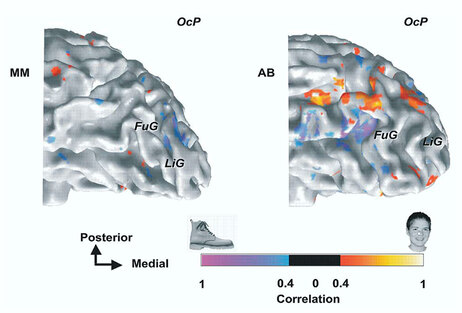
NPR Morning Edition program reports that people who have been blind since childhood may not be able to see so well after sight-restoring surgery as adults. That is because their brains have rewired themselves, so to speak, to accommodate the vision loss.

In the case described by NPR, as a child, one man's "visual cells...devoted to fine detail eventually deteriorated." His blindness in early childhood set off a chain reaction as other parts of [his] brain that also depended on visual information suddenly weren't getting it. As a result, he lost both the ability to recognize faces and to tell different kinds of objects apart.

This case was first studied by Ione Fine, an assistant professor of psychology at the University of Washington. The gentleman who was studied Mike May, had been able to see, once upon a time. She wondered, now that he had a good eye, why couldn't his brain pick up where it left off? That's the subject of a paper published earlier this year in the journal Neuron.
Enhanced by Zemanta

Tuesday, April 27, 2010

Systems To Help Blind See Again


Venture Capital Dispatch blog of the Wall Street Journal reported that two companies are working on vision systems to help some blind people see again.

Second Sight Medical Products, Inc. based in Sylmar, Calif. is developing special eyeglasses that transmit pictures to a receiver embedded on the retina. The images are transferred by the optic nerve to the brain. The device is targeted to patients who have lost most of their vision as a result of retinal degeneration and whose nerve connections are still intact.

Israel's Nano Retina Inc. is also developing a similar device. The devices are priced from $50,000 to $100,000. Both companies are now working with insurance companies to have them pick up the costs for patients in need of such devices.

A third company, Optobionics Corp is pursuing a trickier and more costly approach: restoring function to the damaged retina by using the device to stimulate the rods and cones, rather than using the system as an adjunct to the retina. They are looking for funds to enter Phase III trials.

Reblog this post [with Zemanta]

Tuesday, September 29, 2009

In the New York Times Really? column, Anahad O'Connor explores the claim that blindness may heighten other senses. "In one series of studies, neuroscientists at McGill University tested blind and sighted subjects for pitch perception and their ability to locate sounds." The researchers found that "those who were born blind did best," while "those who became blind as small children were slightly behind, and those who lost their vision after age 10 did no better than the sighted subjects," indicating that a young brain could be rewired so that visual-processing areas were used for other purposes.

Meanwhile, brain-imaging studies indicated that blind subjects who were best able to locate sound were engaging both the auditory and the visual areas of the cortex.
Here is a nice summary of the visual system from Mcgill's guided tour of the brain

Reblog this post [with Zemanta]

Monday, September 28, 2009

Researchers advancing new ways of helping blind people see


On its front page, the New York Times reported that 38 patients from the US, Europe, and Mexico are beginning an intensive three-year research project involving electrodes surgically implanted in their eyes, a camera on the bridge of their noses, and a video processor strapped to their waists, in a burst of recent research aimed at one of science's most-sought-after holy grails: making the blind see.


Researchers involved in the project, the artificial retina, say they have plans to develop the technology to allow people to read, write and recognize faces. Meanwhile, other approaches to treating blindness include gene therapy, which has produced improved vision in people who are blind from one rare congenital disease. Stem cell research is considered promising, although far from producing results, and other studies involve a light-responding protein and retinal transplants.

Reblog this post [with Zemanta]

Thursday, September 24, 2009

Information System for Blind and Visually Impaired

The artificial intelligence group at Freie Universität Berlin, under the direction of the computer science professor Raúl Rojas, has developed a new type of information system for blind and visually impaired individuals.

“InformA” is a small computer that is connected wirelessly to the Internet. The device is operated like a radio. The user can choose between different information channels. By pressing a button, the time or the weather will be announced, but there are also current newspapers available as audio files...

via Google Blogoscoped

Monday, August 17, 2009

Gene Therapy Creates a New Fovea


Gene therapy for an inherited form of blindness shows promise, a U.S. study shows.

According to a study published in the Aug. online edition of Human Gene Therapy and in a letter to the editor in the Aug. 13 issue of the New England Journal of Medicine, experimental gene therapy appeared to improve vision in three patients with Leber congenital amaurosis. In this condition an abnormal protein in sufferers' photoreceptors severely impairs their sensitivity to light. "It's like wearing several pairs of sunglasses in a dark room," says Artur Cideciyan, a researcher at the University of Pennsylvania in Philadelphia, who oversaw the trial

For the study, researchers from the University of Pennsylvania injected a gene encoding a functional copy of a light-sensitivity protein into a small part of one eye of three patients, all in their twenties and blind since birth. Three months after treatment, all three patients showed substantial improvements in their ability to detect light. Notably, one year after treatment, one patient discovered that she could read an illuminated clock in the family car for the first time in her life.

The authors suggested that the brain can adapt to new sensory capacity, even in people who have been blind since birth

Reblog this post [with Zemanta]

Monday, August 03, 2009

Genetic Link To Age-related Cataracts Uncovered


Researchers from Case Western Reserve University have identified the EphA2 gene, which is associated with the formation of age-related cataract, a leading cause of blindness.


The gene encodes an enzyme that plays a role in the repair of damaged proteins in the eye. Expression of the EphA2 gene decreases with age, which means damaged proteins can clump together and cause the eye lens to become cloudy, resulting in obscured vision, according to the study in the July 31 issue of the journal PLoS Genetics

Reblog this post [with Zemanta]

Thursday, June 18, 2009

Red Meat Linked To Blindness in Old Age

A new study from Australia suggests that eating lots of red meat is linked to a higher risk of developing age-related macular degeneration (AMD), a leading cause of blindness in old age.

The study was the work of first author Dr Elaine Chong, who is from the Centre for Eye Research Australia based at the University of Melbourne, and colleagues, and is published on 1 April in the advance access issue of the American Journal of Epidemiology.

The results showed that:

* At follow up, 1,680 participants had early stage AMD and 77 had late stage AMD.

* Higher red meat intake was positively associated with early AMD (ie more red meat linked to higher chance of having early AMD).

* The odds ratio for eating meat ten times a week or more versus eating it less than 5 times a week was a significant 1.47 (ie eating meat 10 times a week gave a person 47 per cent higher risk of AMD than if they ate it less than 5 times a week).

* Conversely, eating chicken 3.5 times a week or more was linked to 57 per cent lower risk of late AMD compared to eating it less than 1.5 times a week.

Reblog this post [with Zemanta]

Wednesday, June 17, 2009

TV segment features device designed to restore some vision to the blind

NBC Nightly News reported that a new device offers the enormous promise of restoring sight for those who don't have it. Chief science correspondent Robert Bazell interviewed Kathleen Blake, once totally blind, but now able to see, thanks to a tiny TV camera mounted on her sun glasses that sends images to electrodes placed on the back of her eye.

For 20 years, Dr. Mark Humayun and his team at the University of Southern California (USC) have been working toward the amazing goal of restoring vision to the blind. Not long ago, the USC researchers achieved great improvement in the device, going from 16 electrodes to 60, enabling better sight. According to Bazell, Soon, the glasses will go. Armand Tanguay, an electrical engineer, is developing cameras to be implanted directly in the eye lens in a system many scientists believe will restore better and better sight to millions.

Thursday, December 11, 2008

Diabetes-related eye diseases may skyrocket over next four decades

The New York Times reports that, according to a study published Dec. 9 in the Archives of Ophthalmology, diabetes-related eye diseases will skyrocket over the next four decades, with elderly Hispanics and blacks hit hardest because of higher rates of Type 2 diabetes.

In particular, the report projects that the number of adults 40 and older with diabetic retinopathy -- the leading cause of blindness among working-age adults -- will reach 16 million in 2050, up from 5.5 million in 2005. In addition, the study estimates that the number of diabetics with glaucoma will quadruple to 1.4 million, while the number with cataracts will more than triple to 10 million. Study author Jinan B. Saaddine, M.D., M.P.H., of the Centers for Disease Control and Prevention (CDC), said the findings are a call for to do more to prevent diabetes to start with.

Thursday, October 23, 2008

Medford (OR) Mail Tribune profiles Karen Barlow, a legally blind, independent businesswoman who teaches computer skills to the visually impaired in the Rogue Valley. Barlow's business, Barlow's Computer Training, has contracts with several organizations, including the U.S. Department of Veterans Affairs' Southern Oregon Rehabilitation Center and Clinics.

The Mail Tribune adds, Barlow is one of 50 vendors demonstrating adaptive technologies and other aids to employment at this week's "'Options for Success' conference.

Sponsored by the Office of Vocational Rehabilitation Services, the seminar's theme is "attitudes for success." Advocacy, referral, work-incentive programs and inspirational speeches fill the sessions, which began Tuesday morning.

The goal is to improve the self-esteem and promotional skills of disabled persons eager to join the workforce, said Kristi Hyman of OVRS.

Twitter Delicious Facebook Digg Stumbleupon Favorites More

 
Design by Free WordPress Themes | Bloggerized by Lasantha - Premium Blogger Themes | Bluehost Review