Showing posts with label Brain. Show all posts

Monday, September 13, 2010

Blindness May Be As Much A Function Of The Brain As Of The Eye


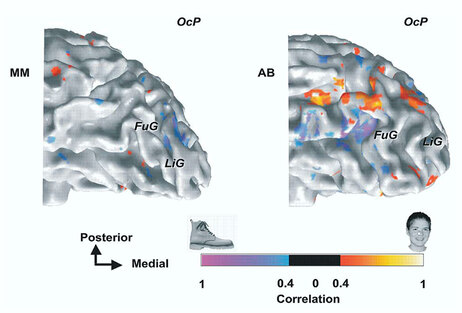
NPR Morning Edition program reports that people who have been blind since childhood may not be able to see so well after sight-restoring surgery as adults. That is because their brains have rewired themselves, so to speak, to accommodate the vision loss.

In the case described by NPR, as a child, one man's "visual cells...devoted to fine detail eventually deteriorated." His blindness in early childhood set off a chain reaction as other parts of [his] brain that also depended on visual information suddenly weren't getting it. As a result, he lost both the ability to recognize faces and to tell different kinds of objects apart.

This case was first studied by Ione Fine, an assistant professor of psychology at the University of Washington. The gentleman who was studied Mike May, had been able to see, once upon a time. She wondered, now that he had a good eye, why couldn't his brain pick up where it left off? That's the subject of a paper published earlier this year in the journal Neuron.
Enhanced by Zemanta

Tuesday, April 27, 2010

Systems To Help Blind See Again


Venture Capital Dispatch blog of the Wall Street Journal reported that two companies are working on vision systems to help some blind people see again.

Second Sight Medical Products, Inc. based in Sylmar, Calif. is developing special eyeglasses that transmit pictures to a receiver embedded on the retina. The images are transferred by the optic nerve to the brain. The device is targeted to patients who have lost most of their vision as a result of retinal degeneration and whose nerve connections are still intact.

Israel's Nano Retina Inc. is also developing a similar device. The devices are priced from $50,000 to $100,000. Both companies are now working with insurance companies to have them pick up the costs for patients in need of such devices.

A third company, Optobionics Corp is pursuing a trickier and more costly approach: restoring function to the damaged retina by using the device to stimulate the rods and cones, rather than using the system as an adjunct to the retina. They are looking for funds to enter Phase III trials.

Reblog this post [with Zemanta]

Tuesday, September 29, 2009

In the New York Times Really? column, Anahad O'Connor explores the claim that blindness may heighten other senses. "In one series of studies, neuroscientists at McGill University tested blind and sighted subjects for pitch perception and their ability to locate sounds." The researchers found that "those who were born blind did best," while "those who became blind as small children were slightly behind, and those who lost their vision after age 10 did no better than the sighted subjects," indicating that a young brain could be rewired so that visual-processing areas were used for other purposes.

Meanwhile, brain-imaging studies indicated that blind subjects who were best able to locate sound were engaging both the auditory and the visual areas of the cortex.
Here is a nice summary of the visual system from Mcgill's guided tour of the brain

Reblog this post [with Zemanta]

Twitter Delicious Facebook Digg Stumbleupon Favorites More

 
Design by Free WordPress Themes | Bloggerized by Lasantha - Premium Blogger Themes | Bluehost Review